
 English
 Español
Customer expresses intent; Communicate between the two parties; Provide analysis reports to customers; Reach a cooperation intention.
Content
- 1 What Is a Metal Canopy and Why It Outperforms Other Materials
- 2 Common Metal Canopy Types and Their Best-Fit Applications
- 3 Steel vs. Aluminum: Choosing the Right Metal for Your Canopy
- 4 Key Design Parameters Every Buyer Should Understand
- 5 Installation Process: From Site Survey to Final Inspection
- 6 Metal Canopy Cost Breakdown: What Drives the Price
- 7 Metal Canopy Maintenance: What to Inspect and How Often
- 8 Aesthetic Options: Making a Metal Canopy Work for Any Architecture
- 9 Building Code and Safety Requirements for Metal Canopies
- 10 How to Evaluate and Select a Metal Canopy Supplier
- 11 Frequently Asked Questions About Metal Canopies
- 11.1 How long does a metal canopy typically last?
- 11.2 Do I need a building permit to install a metal canopy?
- 11.3 What is the difference between a canopy and an awning?
- 11.4 Can a metal canopy be retrofitted with solar panels?
- 11.5 What maintenance does a metal canopy need in winter?
- 11.6 How are metal canopy columns protected from vehicle impact?
What Is a Metal Canopy and Why It Outperforms Other Materials
A metal canopy is a roof-like overhead structure fabricated from steel, aluminum, or other metal alloys, designed to shelter an entrance, walkway, loading dock, fuel station, or outdoor area from rain, sun, and wind. Unlike fabric awnings or polycarbonate covers, a metal canopy delivers decades of service with minimal upkeep, retains its structural integrity under heavy snow loads or high winds, and can be engineered to meet local building codes for both commercial and industrial applications.
The core advantage of metal over other canopy materials is longevity combined with load capacity. Galvanized steel canopy frames routinely carry live loads of 25–50 lbs per square foot, handle wind speeds exceeding 110 mph when properly anchored, and last 40–60 years in typical climates. Fabric canopies rarely survive beyond 10–15 years even with periodic replacement of the cover, and polycarbonate panels yellow and become brittle after prolonged UV exposure. For any permanent installation where replacement cost and downtime matter, metal is the straightforward first choice.
Metal canopies are also highly versatile in form. They can be flat, pitched, curved, or barrel-vaulted. The roofing panel itself may be standing seam steel, corrugated galvanized iron, aluminum composite, or even perforated metal for partial shade rather than full shelter. This range of configurations means a metal canopy can serve a big-box retail entrance, a hospital drop-off, a residential carport, or a railroad platform with equal effectiveness.
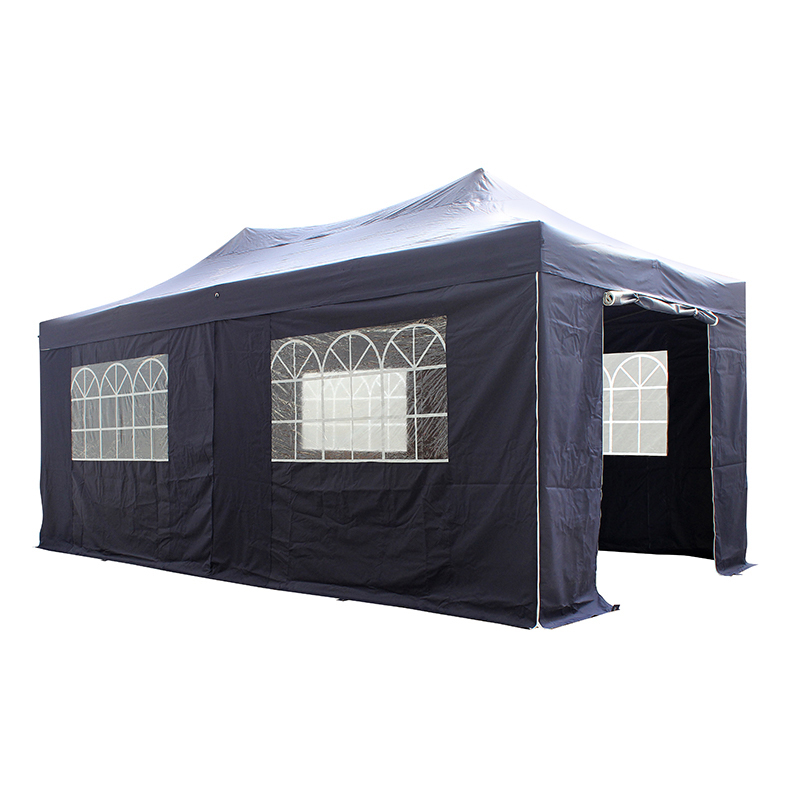
Common Metal Canopy Types and Their Best-Fit Applications
Choosing the right canopy type starts with understanding what each configuration is built to do. Below is a breakdown of the most widely specified categories.
Entrance and Storefront Canopies
These canopies project horizontally from a building facade over a main entry door or lobby. They are typically fabricated from powder-coated aluminum extrusions or light steel and measure 4–10 feet in projection depth. Standard widths range from 6 to 30 feet, though custom widths are common for large commercial projects. An entrance canopy protects visitors from rain while they wait for doors to open, reduces interior water tracking, and functions as a branding surface when finished with signage panels. Hotels, hospitals, office towers, and retail chains are the primary buyers.
Loading Dock and Industrial Canopies
A loading dock canopy shelters the dock door opening, the leveler, and the first several feet of the truck bed so workers can transfer goods without exposure to rain or direct sun. These structures are built from heavier-gauge steel—typically 12- or 14-gauge structural tube—because forklifts and pallet jacks may brush against the support columns. Projection depths of 8–14 feet are standard. Galvanized or hot-dip zinc coated finishes are common in food-processing environments where washdown with high-pressure water is routine.
Fuel Station and Drive-Through Canopies
Fuel canopies are freestanding structures supported by four or more columns with no attachment to an adjacent building. Spans of 40–80 feet in one direction are typical, covering multiple pump islands. Because they are fully exposed on all sides, structural engineers must account for uplift forces as well as lateral wind loads. Steel wide-flange columns embedded in deep concrete piers are the norm. Drive-through canopies at fast-food restaurants follow a similar logic but may use slimmer aluminum columns to keep sight lines open for security cameras.
Walkway and Connector Canopies
Walkway canopies link two buildings or extend shelter along a long facade—common in healthcare campuses, airports, university complexes, and transit hubs. These run in linear modules that repeat every 6–10 feet, each supported by a single column on one side and anchored to the building on the other. Because pedestrian clearance is required, column-to-beam connections must keep the structure above 7.5 feet clear height. Aluminum is preferred for walkway canopies because lower dead weight means smaller anchors and fewer structural interventions to the existing building.
Carport Canopies
A metal carport canopy covers one or more parking spaces without enclosing the sides. Single-car models are typically 12 feet wide by 20 feet long; double models run 20–24 feet wide. In commercial parking facilities, rows of carport canopies are increasingly topped with photovoltaic solar panels—the canopy serves double duty as weather protection and a mounting platform for energy generation. A 100-stall solar carport array on a big-box store can generate 200–400 kW of peak power depending on latitude.
Steel vs. Aluminum: Choosing the Right Metal for Your Canopy
Both steel and aluminum are legitimate choices for a metal canopy, but they excel in different scenarios. The table below summarizes the practical differences.
| Property | Galvanized Steel | Aluminum Alloy (6061-T6) |
|---|---|---|
| Tensile Strength | ~400 MPa | ~310 MPa |
| Weight | ~7,850 kg/m³ | ~2,700 kg/m³ (65% lighter) |
| Corrosion Resistance | Moderate (requires zinc coating or paint) | Excellent (forms natural oxide layer) |
| Weldability | Excellent | Good (requires TIG/MIG with filler rod) |
| Relative Cost (material) | Lower | 20–40% higher |
| Maintenance Cycle | Repaint every 10–15 years | Anodize once; minimal recoating needed |
| Best Applications | Heavy-load industrial, dock canopies, large freestanding | Entrance, walkway, coastal environments |
In coastal regions where salt air accelerates oxidation, aluminum consistently outperforms painted steel even when steel is properly primed and topcoated. A steel canopy installed within half a mile of the ocean can show surface rust within 3–5 years if the coating is scratched or abraded. Aluminum in the same environment develops a thin, self-sealing oxide layer that halts further corrosion without any intervention. This makes aluminum the default choice for marinas, beachfront resorts, and port facilities.
On the other hand, steel makes more economic sense for wide-span structures. A freestanding fuel canopy spanning 60 feet needs columns with substantial moment capacity. Achieving that in aluminum would require much larger section sizes, which defeats the visual lightness that aluminum normally provides. Steel wide-flange beams and columns deliver the required rigidity at lower cost and with connection details that welders and ironworkers handle routinely.
Key Design Parameters Every Buyer Should Understand
When you engage a canopy supplier or structural engineer, the conversation will center on a handful of measurable inputs. Getting these right at the start prevents costly redesigns late in the procurement process.
Projection Depth and Width
Projection depth is how far the canopy extends from the building wall or support column to the outermost edge. For an entrance canopy, a depth of 5–8 feet keeps most visitors dry during moderate rain. At greater projection depths—10 feet or more—the canopy begins to feel more like a covered porch and typically requires a mid-span support or a larger fascia beam to limit deflection. Width is usually dictated by the door or bay opening being covered, with additional feet added on each side to prevent rain blowback from reaching the opening.
Live Load and Snow Load
Live load refers to transient forces—people walking on a maintainable flat canopy surface, maintenance workers, accumulated water before it drains. Most commercial canopies are designed for a minimum 20 psf live load per IBC requirements. Snow load depends on geographic location and roof slope; in high-snow areas like the northern United States, Scandinavia, or alpine regions, ground snow loads can reach 60–100 psf, and the canopy must be designed accordingly with steeper pitch or robust framing to shed snow before accumulation becomes dangerous.
Wind Uplift
Canopies fail in wind not because wind pushes them down, but because it lifts them up. A large flat canopy acts like an airplane wing in a strong gust—suction on the upper surface combined with pressure on the underside creates uplift forces that can literally tear the structure from its anchors. Designing for uplift means specifying anchor bolts with adequate embedment depth in the concrete footing and using moment connections at column bases rather than simple pin connections. In hurricane zones, uplift design forces may govern the entire structure, requiring anchor bolts 18–24 inches deep in reinforced concrete piers.
Roof Slope and Drainage
Standing water is the enemy of any canopy roof panel, including metal ones. A minimum slope of 1/4 inch per foot is generally required for water to drain reliably. Most metal canopy designs use a slope of 1:12 to 3:12 (roughly 5–14 degrees). Drainage can be directed to the front edge as a drip, to internal downspouts hidden within hollow support columns, or to rear gutters that tie into the building's stormwater system. Internal downspouts are preferred on entrance canopies because they eliminate the visual clutter of exposed gutter hardware.
Finish and Coating System
For aluminum canopies, powder coating is the most common finish, available in any RAL or Pantone color and typically specified at 2–3 mil dry film thickness. Anodizing is an alternative that penetrates the metal surface rather than sitting on top—it won't chip or flake but is limited to metallic and neutral color ranges. For steel, a two-coat system of zinc-rich primer plus polyurethane topcoat gives 15–20 years of protection in normal urban environments. Hot-dip galvanizing—immersing the fabricated steel in molten zinc—offers superior protection and is standard for industrial applications.
Installation Process: From Site Survey to Final Inspection
A well-managed metal canopy installation follows a clear sequence. Shortcuts at any stage tend to create problems that are expensive to fix after the structure is in place.
- Site survey and measurements: A field technician measures the opening width, checks the building wall for plumb and level, identifies existing utilities below grade (critical before drilling anchor holes), and photographs the connection points. This typically takes 1–2 hours for a standard entrance canopy.
- Engineering and permit submission: Structural drawings, load calculations, and connection details are submitted to the local building department. Permit review takes anywhere from 2 days to 6 weeks depending on jurisdiction and project complexity. Complex freestanding canopies over 200 square feet almost always require stamped engineering drawings from a licensed PE.
- Fabrication: Once the permit is approved and shop drawings are finalized, the canopy components are cut, welded or bolted together, and finished in the fabricator's facility. Lead times for standard designs run 3–6 weeks; custom or large-scale projects may require 8–14 weeks.
- Foundation and anchor preparation: If the canopy is freestanding, concrete footings are poured with anchor bolt assemblies embedded at the correct bolt circle and projection. Footing depth is determined by soil conditions and frost depth—in northern climates, footings may need to go 4–5 feet below grade to stay below the frost line.
- Structural erection: For wall-mounted canopies, lag bolts or through-bolts anchored into studs, masonry, or the structural frame of the building secure the back bar. Columns are set on base plates, leveled, and grouted. Fascia beams, purlins, and roof panels are installed in sequence. A standard 10-foot by 20-foot entrance canopy typically takes one experienced crew of two 4–6 hours to erect.
- Roof panel installation: Standing seam, corrugated, or flat metal panels are fastened to the purlins and seamed or lapped according to the manufacturer's specifications. Flashing and sealant are applied at the wall interface to prevent water infiltration into the building.
- Final inspection: The building inspector verifies that the installation matches the approved drawings, anchors are correctly installed, and there are no open penetrations. A certificate of occupancy or final sign-off is issued.
Skipping the permit step is a risk that buyers sometimes take to save time and fees, but it can result in a stop-work order, mandatory removal, or complications during property sale when the unpermitted structure appears in a title search.
Metal Canopy Cost Breakdown: What Drives the Price
Buyers often ask for a quick per-square-foot price, but canopy pricing doesn't compress to a single number because several independent variables drive cost in different directions simultaneously. The ranges below reflect typical U.S. market pricing as of recent years; international markets vary by local labor and material costs.
| Canopy Type | Typical Size | Installed Cost Range (USD) | Primary Cost Driver |
|---|---|---|---|
| Residential aluminum carport | 12 ft × 20 ft | $3,500 – $8,000 | Kit vs. custom fabrication |
| Commercial entrance canopy | 8 ft × 16 ft | $8,000 – $25,000 | Custom profile, finish, signage |
| Loading dock canopy | 12 ft × 14 ft per bay | $6,000 – $18,000 per bay | Steel gauge, column footing |
| Freestanding fuel/drive-through | 40 ft × 60 ft | $60,000 – $180,000 | Span, wind zone, number of columns |
| Walkway canopy (per linear ft) | 6 ft wide | $350 – $900 per linear ft | Column spacing, attachment complexity |
Beyond the base fabrication and installation cost, several line items are easy to overlook in early budgeting:
- Engineering fees: A stamped structural drawing from a licensed engineer typically costs $800–$3,000 depending on complexity. This is non-negotiable for permitted projects.
- Permit fees: Typically 1–3% of the project construction value, varying by municipality.
- Electrical rough-in: If the canopy includes lighting, a licensed electrician must run conduit and wire to junction boxes before the structure is closed up. Budget $500–$2,000 for a basic lighting circuit on a standard canopy.
- Concrete footing work: For freestanding canopies, concrete footings may cost $800–$3,000 each depending on depth and diameter, and most designs require two to four footings.
- Freight: Large fabricated canopy components ship via flatbed truck; freight from the fabrication facility to the job site can add $500–$5,000 for distant locations.
Metal Canopy Maintenance: What to Inspect and How Often
One of the strongest arguments for a metal canopy is how little routine maintenance it requires compared to fabric or wood structures. That said, "low maintenance" does not mean "no maintenance." A simple annual inspection catches small issues before they become structural problems.
Annual Inspection Checklist
- Check all anchor bolts and base plate connections for looseness, elongated holes, or cracked grout. Retighten or re-grout as needed.
- Inspect the wall-to-canopy flashing for gaps or lifted edges that allow water to infiltrate behind the canopy and into the building wall assembly.
- Clear all downspouts and gutters of leaf litter and debris. Blocked drainage causes water to pond on the roof surface, accelerating joint fatigue and seam corrosion.
- Look for paint bubbling, rust staining, or white powdery deposits on aluminum surfaces (the latter indicates oxidation of the substrate rather than the oxide layer and may require professional cleaning and re-anodizing).
- Check welded joints and bolted connections for any visible cracking. Cracks in welds are rare on quality fabrications but must be repaired immediately if found, as they can propagate rapidly under repeated wind or thermal load cycling.
- After any major storm, visually inspect for bent fascia members, dislodged roof panels, or shifted columns. Report any deviation from plumb immediately to a structural professional.
Recoating and Touch-Up
For powder-coated aluminum, small scratches or chips can be touched up with matching touch-up paint from the original finisher to prevent moisture from reaching the base metal. A full recoat of a powder-coated aluminum canopy is rarely needed before 20–25 years if the original application was properly cured and the surface is not in an extremely harsh environment. For painted steel canopies, a full repaint is typically warranted every 10–15 years. Surface preparation—removing loose paint, sanding, and priming bare metal spots—accounts for 60–70% of the cost of a repaint job, so thorough prep is worth the time investment.
Aesthetic Options: Making a Metal Canopy Work for Any Architecture
A widespread misconception is that a metal canopy looks industrial or utilitarian—fine for a warehouse but out of place on a boutique hotel or a suburban medical clinic. In practice, metal canopies are among the most architecturally adaptable overhead shelter solutions available, because the profile of every structural component and the choice of panel type can be tailored extensively.
For traditional or classical building facades, a curved or barrel-vault canopy in powder-coated aluminum with decorative brackets and a white finish reads as elegant rather than industrial. For contemporary glass-and-steel office towers, a flat canopy with slim-profile fascia beams, exposed structural tension rods, and a dark bronze anodized finish complements the building's language. Retail environments often want backlit signage panels integrated into the canopy soffit—metal canopy manufacturers routinely build light boxes into the underside of the fascia so brand graphics are visible at night.
Perforated metal panels are gaining popularity on canopies where full waterproofing is not needed but shade is. The perforation pattern—circular, square, or custom laser-cut shapes—can be specified to achieve 20%, 40%, or 60% open area, controlling how much direct sun reaches the space below. On pedestrian plazas and outdoor dining areas, a perforated metal canopy creates the sense of shelter without blocking breezes or making the space feel enclosed.
Cor-Ten (weathering steel) canopies are another aesthetic choice, particularly popular in museum, civic, and landscape architecture projects. The steel intentionally oxidizes to form a stable rust-colored patina that protects the base metal from further corrosion. This distinctive amber-brown finish requires no painting and weathers predictably over 3–5 years to its final color. It is not appropriate in areas where the initial rust runoff could stain adjacent paving or building surfaces during the weathering phase.
Building Code and Safety Requirements for Metal Canopies
Every jurisdiction with a building code regulates canopies as permanent structures attached to or adjacent to buildings. In the United States, the International Building Code (IBC) is the model code adopted in most states, often with local amendments. Key code provisions that affect canopy design include:
- IBC Section 3105 (Canopies): Defines a canopy as a structure over a door, entrance, window, or outdoor service area that is open on three or more sides. It must be constructed of approved noncombustible materials—metal qualifies—and must be structurally independent of the building's fire protection systems unless the canopy is fully enclosed on additional sides, at which point it becomes a covered mall or occupancy change.
- ASCE 7 loading standard: Structural engineers use ASCE 7 to calculate wind, snow, and seismic loads for canopy design. The edition of ASCE 7 referenced by the local building code (currently ASCE 7-22 in most jurisdictions) includes detailed tables of ground snow loads and basic wind speeds by location.
- ADA clearance: The Americans with Disabilities Act requires a minimum clear head height of 80 inches (6 feet 8 inches) along any accessible pedestrian route. A canopy over an accessible entrance must maintain this clearance across its full width, which affects the minimum height at the outer edge for sloped canopy designs.
- Fire separation distance: If the canopy is located within a certain distance of a property line or another building, local codes may require the canopy panels to have a fire-resistance rating. Metal inherently performs well here—steel and aluminum are noncombustible—but any insulation or underlayment used in the panel assembly must also meet noncombustible or limited-combustible standards.
- Electrical code: Canopy lighting and any electrically operated components (heated gutters, powered signs) must comply with NFPA 70 (National Electrical Code) and be installed by a licensed electrician with the appropriate permits.
Outside the United States, equivalent standards apply—EN 1993 (Eurocode 3) governs steel design in Europe, AS 4055 covers wind loads in Australia, and IS 875 addresses loads in India. Any qualified canopy manufacturer supplying international markets should be familiar with the relevant code family for the destination country.
How to Evaluate and Select a Metal Canopy Supplier
The canopy market includes everything from large national manufacturers with in-house engineering teams to local metal fabrication shops that build canopies as a side line. Both can deliver quality results, but the evaluation criteria differ by project scale and complexity.
For Standard Commercial Projects
Ask prospective suppliers for at least three completed project references from the past two years that are similar in scope and application. Request photos and, if possible, a site visit. Confirm that the supplier provides stamped engineering drawings as part of their standard scope, not as an optional add-on. Ask specifically whether the engineering is done in-house or subcontracted, and whether the engineer carries current professional liability (E&O) insurance. Verify that the fabricator holds current AISC certification (for steel) or equivalent quality certification, which confirms that their welding procedures and quality control systems meet industry standards.
For Large or Custom Projects
Large-span canopies or architecturally complex designs warrant a more rigorous vetting process. Issue a Request for Qualifications (RFQ) before requesting pricing, asking suppliers to document their experience with spans and loads similar to the project. Review their shop drawing process—quality suppliers produce detailed fabrication drawings reviewed by an engineer of record before any steel is cut. Ask for a copy of their quality control plan, including how dimensional tolerances are checked during fabrication and how non-conforming work is handled. For projects over $100,000, a site visit to the fabrication facility is a reasonable and worthwhile request.
Warranty Terms to Review
A reputable metal canopy supplier should provide a minimum 1-year labor warranty on installation and a separate manufacturer's warranty on the structural components—typically 5–10 years against defects in fabrication. Finish warranties vary by product: powder coat warranties typically run 5 years for fade and chalk; anodized finishes are often warranted for 10 years. Examine the exclusions carefully—warranties commonly exclude corrosion caused by industrial pollutants, marine environments, or contact with incompatible metals (galvanic corrosion between aluminum and uncoated steel fasteners, for example).
Frequently Asked Questions About Metal Canopies
How long does a metal canopy typically last?
A properly designed and maintained metal canopy lasts 40–60 years in most climates. Aluminum canopies in coastal environments have documented service lives exceeding 50 years when the original anodize or powder coat is maintained. Steel canopies last equally long when the coating system is repainted on schedule, typically every 10–15 years.
Do I need a building permit to install a metal canopy?
In most jurisdictions, yes. Any permanent overhead structure attached to a building or set on its own foundation is subject to local building permit requirements. Penalties for unpermitted structures include mandatory removal and fines. The permit process also ensures that the structure is properly engineered for local wind and snow conditions, protecting occupants.
What is the difference between a canopy and an awning?
The terms are often used interchangeably, but technically an awning is a fabric or flexible covering attached only to the building and typically retractable, while a canopy is a rigid structure supported by its own columns or brackets in addition to a wall attachment. Metal structures are almost always referred to as canopies rather than awnings.
Can a metal canopy be retrofitted with solar panels?
Yes, and this is increasingly common. Existing canopies can be retrofitted with solar panels if the original structure was designed with sufficient load capacity for the additional dead load of the panels (typically 3–5 lbs/sq ft) plus the increased wind load from the panels' larger surface area. An engineer should assess the existing structure before solar panels are added. New canopy designs intended for solar from the outset are optimized for panel tilt angle and structural efficiency.
What maintenance does a metal canopy need in winter?
In snow climates, the primary winter maintenance task is removing accumulated snow from flat or low-slope canopies after heavy snowfall events, particularly when snow is wet and heavy (wet snow weighs 20–40 lbs per cubic foot compared to 5–10 lbs for dry powder snow). Use a plastic snow rake rather than metal tools to avoid scratching the roof surface. Keep gutters and downspouts clear so meltwater drains freely and does not refreeze and create ice dams at the eave.
How are metal canopy columns protected from vehicle impact?
Column guards—also called bollard covers or pipe guards—are the standard solution. These are steel sleeves or independent bollards set in concrete around or near the column base to absorb vehicle impact before it reaches the structural column. In fuel station and drive-through canopy applications, column guards are almost always specified as part of the original installation. For existing canopies where vehicles have damaged columns, galvanized steel pipe bollards filled with concrete are the most cost-effective retrofit protection.

