English
 Español
Customer expresses intent; Communicate between the two parties; Provide analysis reports to customers; Reach a cooperation intention.
Content
- 1 What Is a Canopy in Architecture? The Direct Answer
- 2 The Primary Functions of an Architectural Canopy
- 3 Types of Architectural Canopy by Structure and Form
- 4 Architectural Canopy Materials Compared
- 5 Historical Development of the Architectural Canopy
- 6 Designing an Architectural Canopy: Key Engineering and Design Considerations
- 7 Notable Architectural Canopy Examples Around the World
- 8 Canopy in Sustainable and Green Building Design
- 9 Architectural Canopy vs. Related Architectural Elements
- 10 Practical Guide to Specifying an Architectural Canopy
What Is a Canopy in Architecture? The Direct Answer
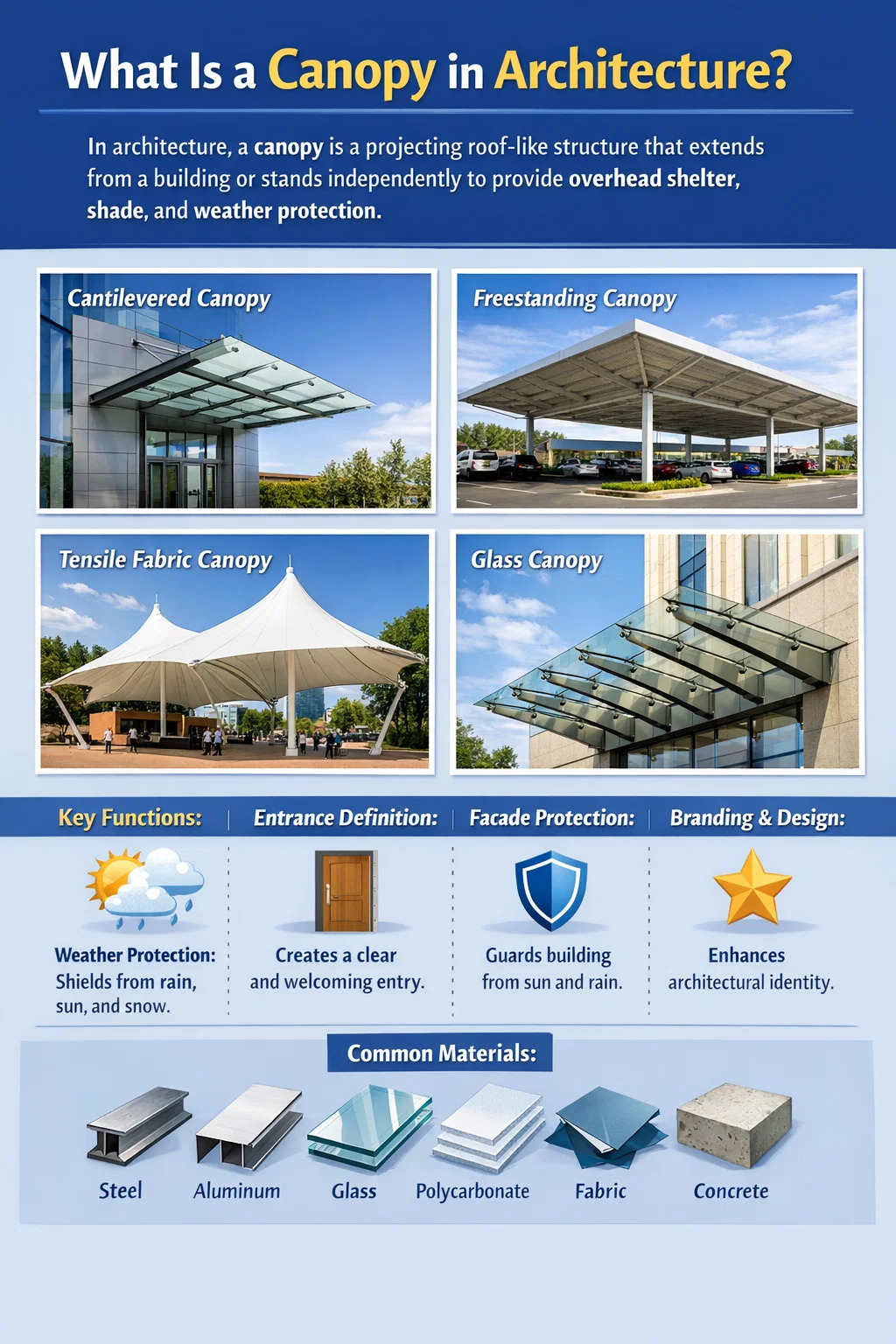
In architecture, a canopy is a projecting roof-like structure that extends from a building or stands independently to provide overhead shelter, shade, and weather protection for people moving through or occupying a space beneath it. It is typically positioned over entranceways, walkways, loading areas, outdoor plazas, or building facades, and it functions as a transitional element between the interior of a building and the open environment outside.
An architectural canopy is not simply a decorative feature — it is a functional building element that manages sun, rain, wind, and pedestrian comfort simultaneously. It can be constructed from steel, aluminum, glass, polycarbonate, timber, tensioned fabric, or reinforced concrete, and its design is governed by structural engineering requirements, local building codes, material performance specifications, and aesthetic intent. In contemporary architectural practice, canopies are increasingly designed as signature elements that define a building's identity and entrance experience.
The term derives from the Latin conopeum and Greek konopion, originally meaning a draped covering or net. In the architectural context, it first gained widespread use in Gothic and Renaissance buildings where projecting stone hoods sheltered statues, doorways, and windows. Today, the canopy has evolved far beyond its historical origins into one of the most versatile and expressive elements in the architectural toolkit.
The Primary Functions of an Architectural Canopy
A well-designed architectural canopy performs multiple roles simultaneously. Understanding these functions helps explain why canopies appear on nearly every category of building — from hospitals and airports to retail stores and private residences.
Weather Protection and Environmental Control
The most fundamental function of an architectural canopy is weather protection. It keeps rain, snow, hail, and direct sun off the people and surfaces immediately below it. Over a building entrance, this means visitors arriving by foot or vehicle are shielded while they open doors, search for keys, pay for services, or wait for transport. Over a loading dock, it protects goods and workers during transfer operations. Over a pedestrian walkway, it extends safe usable circulation in all weather conditions.
A canopy projecting 2.5 to 3 meters from a building face provides effective rain protection in winds up to approximately 30–40 km/h, which covers the majority of non-storm rainfall events. In hotter climates, canopies reduce solar heat gain on the building facade beneath them, cutting cooling loads on glazed entrances and lobbies. Studies in warm-climate cities have measured surface temperature reductions of 10–20°C on shaded pavement versus exposed pavement directly adjacent.
Defining Entrance and Spatial Hierarchy
In architectural design, the entrance of a building is one of the most critical moments in a visitor's experience. A canopy marks and amplifies the entrance, creating a legible threshold between outside and inside. It communicates to approaching visitors where they should go and signals the importance or character of the building before they even step through the door.
This spatial function is particularly significant in large public buildings. The dramatic canopy over the main entrance to Terminal 5 at Heathrow Airport, for instance, extends the terminal's glazed facade into an expansive overhead plane that simultaneously covers vehicle drop-off lanes and orients arriving passengers toward the check-in hall. The canopy here is not just shelter — it is spatial direction, scale, and architectural identity compressed into a single element.
Facade Protection and Building Envelope Performance
Canopies also protect the building envelope directly beneath them. A canopy over a glazed entrance lobby reduces solar gain on the glass, decreasing interior temperatures and cutting air-conditioning costs. It also reduces the amount of rainwater running down the facade adjacent to the entrance, which matters for the longevity of cladding materials, sealants, and door hardware. In heritage buildings, canopies are sometimes retrofitted specifically to protect historically significant stonework or brickwork from continued water exposure.
Branding and Architectural Expression
For commercial and retail architecture, the entrance canopy is a primary branding surface. Its scale, material, color, lighting, and form contribute directly to how the building — and the organization occupying it — is perceived from the street. High-end hotels, flagship retail stores, and corporate headquarters frequently commission bespoke canopy designs that are as carefully considered as any other visible element of the building's exterior. The illuminated glass and steel canopy of a luxury hotel entrance communicates very different values from the tensile fabric canopy of a community sports facility, even if both serve the same basic protective function.
Types of Architectural Canopy by Structure and Form
Architectural canopies are classified by how they are supported, how they are attached, and what geometry they take. Each structural type has specific engineering implications, cost profiles, and aesthetic qualities.
Cantilevered Canopy
A cantilevered canopy projects horizontally from a building wall with no supporting columns at its outer edge. The structure is fixed to the building's frame and relies on the cantilever principle — the wall attachment transfers bending moment into the building's structural system. This type is extremely common over building entrances because it keeps the covered area free of columns, improving pedestrian flow and vehicle clearance.
Cantilevered canopies typically span between 1.5 and 4 meters from the building face, though structurally engineered examples in steel and glass can extend 6–8 meters or more. Beyond approximately 3 meters, the structural depth of the canopy frame increases significantly, and the fixing loads transferred into the building wall become substantial — requiring assessment by a structural engineer. Cantilevered glass canopies suspended from above by steel rods or cable systems allow very slender profiles that appear to float without visible structure.
Freestanding Canopy
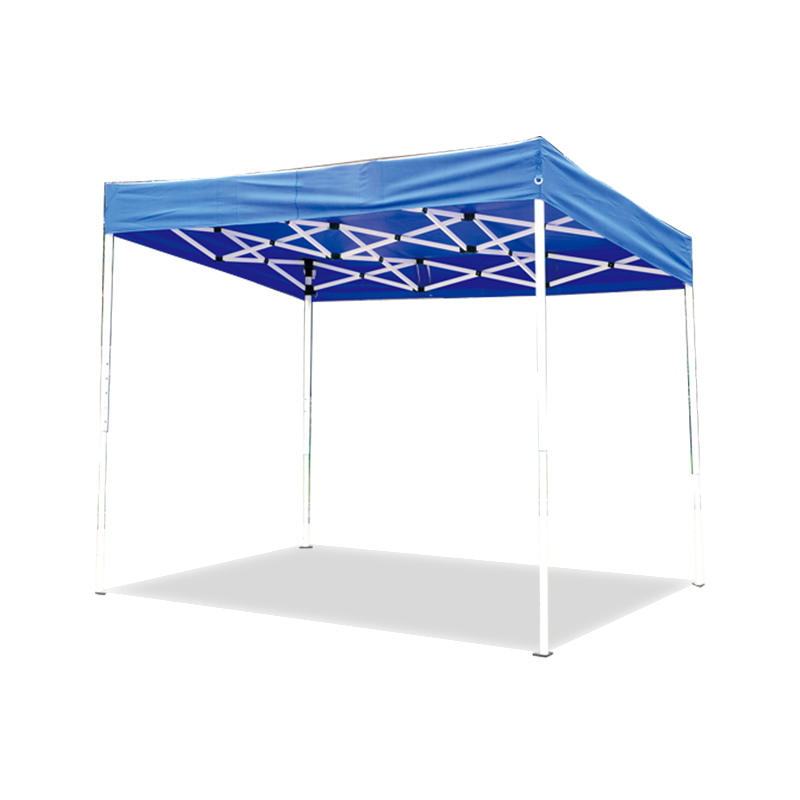
A freestanding canopy is supported entirely by its own columns or posts and is not structurally attached to a building. It may be positioned adjacent to a building, in a car park, over a pedestrian walkway, or in a public plaza. Because its loads are carried entirely to the ground through its own structure, it does not impose loads on a building's frame. This makes freestanding canopies suitable for retrofitting in locations where the existing building structure cannot accept additional loads.
Large freestanding canopies are common in petrol station forecourts, drive-through facilities, bus interchanges, and outdoor market areas. A petrol station canopy typically covers 500–1500 square meters and must clear a height of at least 5.5 meters for tanker vehicle access. These large-span freestanding canopies use portal frame or truss structures in steel to achieve wide column-free spans.
Tensile Fabric Canopy
Tensile canopies use high-strength architectural fabric held in tension between masts, cables, and anchor points to create curved, sculptural overhead surfaces. Unlike rigid canopies, tensile structures achieve stability through geometry — the double-curved anticlastic form (saddle shape) common in tensile canopies is inherently stiff when the fabric is under tension. The fabric itself is typically woven PTFE-coated glass fibre or PVC-coated polyester, both of which have life expectancies of 20–30 years in outdoor conditions.
Tensile fabric canopies are popular in sports stadiums, airports, shopping centres, and public plazas where large covered areas are needed without heavy structural columns. The roof of the Denver International Airport is one of the most recognizable examples — its white PTFE fabric canopy, stretching over 33,000 square meters, creates dramatic peaks that reference the Rocky Mountains visible to the west. Tensile fabric canopies can span column-free distances of 20–60 meters or more, making them effective where other structural systems would require intermediate supports that interrupt sight lines or pedestrian movement.
Glass Canopy
Glass canopies use laminated safety glass panels supported by a steel or aluminum structural frame, or suspended from above by stainless steel fittings and cables. They are valued for their transparency — a glass canopy admits natural light into the space below while still providing weather protection, which is particularly important over glazed entrances and lobbies where maintaining a sense of openness is a design priority.
The glass used in structural canopies is always laminated, with a polyvinyl butyral (PVB) or ionoplast interlayer that holds glass fragments together if the panel breaks. Overhead glazing in architectural canopies is required by building codes in most jurisdictions to be laminated glass with a minimum of two plies, precisely because a falling glass fragment poses a severe risk to people below. Fritted or ceramic-coated glass is commonly used to reduce solar heat gain and glare while maintaining visual transparency from below.
Polycarbonate Canopy
Polycarbonate sheeting is a popular alternative to glass in architectural canopies where cost, weight, and impact resistance are priorities over premium appearance. Twin-wall or multi-wall polycarbonate panels offer a significantly better thermal insulation performance than glass and are impact-resistant — an important property in hail-prone regions. They are approximately 50 times more impact-resistant than glass at equivalent thickness, and they weigh roughly one-sixth as much. However, polycarbonate scratches more easily, yellows over time without UV-stabilized coatings, and is generally perceived as a lower-specification finish than glass in commercial applications.
Solid Roof Canopy in Concrete, Steel, or Timber
Some architectural canopies are built as extensions of the building's primary structure, with solid roofs in reinforced concrete, steel decking, or engineered timber. These are the most permanent and structurally robust option, designed as integral parts of the building rather than attachments or additions. Reinforced concrete canopies are common in brutalist and modernist architecture, where the canopy often reads as a massive horizontal plane that floats above the entrance. Timber canopies are increasingly used in contemporary sustainable architecture, with cross-laminated timber (CLT) or glulam beams creating warm, natural-looking overhead structures that contribute to building certification targets like LEED or Green Star.
Architectural Canopy Materials Compared
Material selection is one of the most consequential decisions in canopy design. It affects structural performance, maintenance requirements, lifespan, cost, and the overall visual character of the canopy within the building's architecture.
| Material | Structural Span | Lifespan | Maintenance | Relative Cost | Best Application |
|---|---|---|---|---|---|
| Structural steel | Up to 20m+ | 40–60 years | Low–Moderate | Medium–High | Commercial, industrial, large public buildings |
| Aluminum | Up to 6m | 30–50 years | Very Low | Medium | Retail, residential, coastal environments |
| Laminated glass | Up to 4m per panel | 25–40 years | Low | High | Premium entrances, hotels, corporate HQ |
| Polycarbonate | Up to 3m per panel | 15–25 years | Low | Low–Medium | Carports, schools, community buildings |
| PTFE-coated fabric | 20–60m+ (tensile) | 25–35 years | Low | High | Stadiums, airports, large public plazas |
| Reinforced concrete | Up to 8m | 50–80 years | Low | Medium | Civic, institutional, brutalist architecture |
| Glulam / CLT timber | Up to 12m | 40–60 years | Moderate | Medium–High | Sustainable, education, community buildings |
Historical Development of the Architectural Canopy
The canopy has been a feature of built architecture for thousands of years, and tracing its history reveals how deeply embedded it is in the way humans think about thresholds, shelter, and the articulation of important spaces.
Ancient and Classical Origins
In ancient Egyptian, Greek, and Roman architecture, projecting cornices and temple porticos performed canopy-like functions — sheltering doorways and transitional spaces while simultaneously signaling status and sacred importance. The Greek temple portico, with its colonnade and projecting entablature, is in structural terms a freestanding canopy: a covered threshold between the sacred interior of the cella and the open precinct beyond. The Romans extended this principle into civic architecture with the elaborately decorated projecting hoods above forum entrances and bath house doors.
Gothic and Renaissance Canopies
In Gothic cathedral architecture, the canopy became a highly refined decorative and protective element. Stone canopies — called baldachins or ciboriums when positioned over altars, and hood molds or drip molds when positioned over doorways and windows — were integral to Gothic architectural vocabulary. The triple-portal arrangement of a Gothic cathedral facade, with its deeply recessed doorways protected by projecting stone canopies carved with crockets, finials, and sculptural programs, represents the canopy at its most architecturally ambitious. These stone hoods protected the carved figures in the tympanum and door jambs from rain erosion while adding visual weight and hierarchy to the entrance composition.
Renaissance architecture reinterpreted the canopy through classical forms — the projecting classical entablature, the pedimented doorhood, and the columned porte-cochère all performed canopy functions while referencing Roman precedent. The porte-cochère, literally "carriage gate," became a standard feature of aristocratic houses and later grand hotels and civic buildings through the eighteenth and nineteenth centuries.
Modernism and the Structural Canopy
The Modern Movement of the twentieth century transformed the canopy from an ornamental feature into a structural expression of new materials and building technologies. Le Corbusier's deployment of thin concrete slabs as horizontal brise-soleils and entrance canopies at buildings like the Unité d'Habitation treated the canopy as a pure tectonic element — no decoration, no historicist references, just honest expression of reinforced concrete's ability to project horizontally without support. Mies van der Rohe's Barcelona Pavilion used an impossibly thin, hovering roof plane that functioned as a canopy over the entire composition, redefining what a sheltering overhead element could be in terms of material economy and spatial drama.
The postwar period brought tensile structures into mainstream architectural use. Frei Otto's work in tensile canopy design — most famously the cable net roof of the Munich Olympic Stadium completed in 1972 — demonstrated that fabric and cable systems could cover enormous areas with minimal material, creating structures of extraordinary lightness and visual transparency. This work directly informed the tensile canopy architecture of subsequent decades.
Designing an Architectural Canopy: Key Engineering and Design Considerations
Designing a canopy that performs reliably over its service life requires careful attention to structural, environmental, and regulatory factors. The following considerations apply to virtually every architectural canopy project regardless of scale.
Structural Load Analysis
Every canopy must be designed to carry the loads it will experience in service. These include:
- Dead load: The self-weight of the canopy structure and its covering material. A steel and glass canopy over a typical commercial entrance might weigh 80–150 kg per square meter of roof area.
- Wind load: Typically the governing load for canopy design. Canopies are exposed structures subject to both downward pressure and upward suction from wind. In cyclone or hurricane zones, wind loads can exceed 2.5 kPa on exposed canopy surfaces, driving significant structural requirements.
- Snow load: In colder climates, accumulated snow can impose substantial loads. A 300 mm snow depth on a flat canopy represents approximately 1.0–1.5 kPa of additional load — enough to collapse an underspecified structure.
- Maintenance access load: Building codes typically require canopies to carry a minimum maintenance live load of 0.5–1.0 kPa to allow for cleaning, repair, and inspection.
- Seismic load: In earthquake-prone regions, canopy connections must be designed to accommodate the dynamic loads generated during a seismic event without separating from the building.
Drainage Design
Canopies collect rainwater, and managing that water is a critical design requirement. A flat canopy with no slope will pond water, accelerate membrane degradation, increase structural load, and eventually leak. Building codes and good practice standards generally require a minimum fall of 1:60 (approximately 1°) on any canopy roof surface, with most designers specifying 1:40 or steeper for reliable drainage. Water can be directed to gutters and downpipes at the canopy perimeter, to central drainage points, or allowed to fall freely from the canopy edge as a design feature (a cascade effect sometimes deliberately incorporated in contemporary architecture).
For glass and polycarbonate canopies, rainwater running off the surface is also a maintenance consideration — it deposits mineral scale and environmental dirt that can stain the canopy and reduce light transmission over time. Designing for easy cleaning access and specifying self-cleaning glass coatings (which use titanium dioxide photocatalysis to break down organic deposits) reduces long-term maintenance burden significantly.
Building Code and Planning Compliance
Architectural canopies are building elements and are subject to building regulations in every jurisdiction. Key compliance areas include:
- Minimum clearance heights over pedestrian paths and vehicle routes. Most codes require a minimum of 2.4 meters above pedestrian walkways and 4.2–5.5 meters above vehicle routes, with higher clearances for truck access areas.
- Overhead glazing safety requirements — laminated glass specifications and framing standards to prevent fragments falling on people below.
- Fire performance requirements, particularly where canopies are close to property boundaries or adjacent buildings.
- In heritage-listed areas and conservation zones, design approval may be required from local heritage authorities before a canopy can be installed, even on non-heritage buildings.
- In many jurisdictions, any canopy projecting over a public footpath or road requires approval from the local council or road authority, with an annual lease or license fee for the use of airspace above the public realm.
Fixing to the Building Structure
How a canopy attaches to a building is often the most technically demanding aspect of its design. For cantilevered canopies, the connection must transfer bending moment, shear, and axial forces into the building's structural frame — not just the facade cladding. This usually means the canopy's primary structural members connect directly to the building's concrete slab, steel columns, or structural masonry walls via cast-in anchors or post-installed anchor bolts. The structural fixing of a cantilevered canopy to an existing building must always be assessed by a structural engineer to confirm the building's frame can accept the added loads, particularly in retrofit situations where the original design may not have anticipated any canopy loads.
Notable Architectural Canopy Examples Around the World
Some of the most compelling demonstrations of what an architectural canopy can achieve come from examining landmark projects where the canopy is central to the building's identity and performance.
The Great Court at the British Museum, London
Designed by Foster + Partners and completed in 2000, the Great Court canopy is a steel and glass grid-shell roof covering the two-hectare central courtyard of the British Museum. The roof structure consists of 3,312 unique triangular glass panels supported by a steel lattice, with no two panels identical due to the geometric complexity of the design. The canopy transformed what was a largely inaccessible outdoor courtyard into one of the largest covered public spaces in Europe, drawing approximately 6 million visitors per year. The glass roof weighs over 800 tonnes and was fabricated and installed without interrupting the Museum's daily operations — a remarkable construction logistics achievement in an extremely constrained central London site.
Denver International Airport Tensile Roof, USA
The Jeppesen Terminal at Denver International Airport features one of the largest tensile fabric canopy roofs in the world. Completed in 1995, the roof covers approximately 33,000 square meters and is made from a two-layer system of PTFE-coated fiberglass fabric stretched between 34 steel masts, creating a series of peaks and valleys that rise to 27 meters at their highest point. The white fabric reflects approximately 90% of incident solar radiation, significantly reducing cooling loads in the terminal despite its vast glazed end walls, and transmits a soft, diffuse natural light throughout the interior. The structure was designed by Fentress Bradburn Architects with the tensile roof engineered by Severud Associates.
Metropol Parasol, Seville, Spain
Designed by Jürgen Mayer H. Architects and completed in 2011, the Metropol Parasol is a freestanding timber canopy structure in the Plaza de la Encarnación in central Seville. At approximately 150 meters long and 70 meters wide, it is often cited as the largest wooden structure in the world. The parasol form — essentially a giant canopy on six mushroom-shaped columns — provides shade for the public plaza below while housing a market at ground level, an archaeological museum beneath, and a rooftop walkway above. The structure is made from laminated timber panels bonded with polyurethane adhesive and coated with a water-resistant polyurethane finish. It serves as a striking example of how an architectural canopy can become a building in its own right — a covered public space that redefines an entire urban precinct.
Apple Store Canopies
Apple's retail architecture, developed with Foster + Partners, uses canopy elements as central design devices. The suspended glass canopy over the Apple Fifth Avenue cube entrance in New York — a 10-meter glass cube with a cylindrical glass elevator descending into the underground store — functions as both canopy and architectural landmark. At Apple Park Visitor Center in Cupertino, a carbon-fiber canopy roof 80 meters on each side cantilevers over the building's glass walls with no visible internal columns, creating an impression of a floating plane over the transparent enclosure. These examples demonstrate how a canopy, when designed at the highest level, becomes the defining architectural gesture of a project.
Canopy in Sustainable and Green Building Design
In the context of green building certification and climate-responsive design, the architectural canopy plays an increasingly important role as a passive environmental control strategy.
Solar Shading and Thermal Performance
A canopy positioned over south-facing (in the northern hemisphere) or north-facing (in the southern hemisphere) glazed walls can substantially reduce solar heat gain through those surfaces during summer months when the sun angle is high. A fixed horizontal canopy designed for a latitude of 35°N that projects 1.5 meters from the building face will shade the glazing below it for approximately four months in summer while allowing low winter sun to penetrate and provide passive solar heating. Appropriately designed solar shading canopies can reduce cooling energy consumption in commercial buildings by 15–30% in warm-climate locations, contributing directly to LEED, BREEAM, or Green Star energy credit points.
Photovoltaic-Integrated Canopies
Building-integrated photovoltaics (BIPV) in canopy roofs represent a growing area of sustainable architectural practice. A canopy roof with solar panels serves a dual function: providing covered shelter below while generating renewable electricity above. Carpark canopies are particularly productive applications — the canopy faces are unobstructed by other structures, angled optimally toward the sun, and cover large areas that would otherwise be productive only as vehicle parking. A 1,000 square meter carpark canopy with high-efficiency monocrystalline PV panels generating 200 W/m² would produce approximately 200 kWp of installed solar capacity, sufficient to offset the electricity consumption of a medium-sized commercial office building. Several major retailers and commercial property developers in Europe and Australia have now installed solar canopies across hundreds of carparks as part of their decarbonization strategies.
Green and Living Canopies
Living canopy structures, which incorporate planted vegetation into the overhead covering, combine the functions of a conventional canopy with those of a green roof or vertical garden. A planted canopy provides shade through foliage cover rather than opaque or transparent panels, offering evaporative cooling benefits as plants transpire moisture. The cooling effect of a planted canopy on the space beneath it can be 3–7°C more pronounced than a conventional solid canopy in summer conditions, depending on the density and species of the planting. These structures are found in shopping centre food courts, airport terminals, and public plazas where biophilic design principles are being applied to improve occupant wellbeing and reduce the urban heat island effect at the building scale.
Architectural Canopy vs. Related Architectural Elements
Several architectural elements are closely related to the canopy and are sometimes confused with it. Understanding the distinctions clarifies both design vocabulary and functional intent.
| Element | Definition | Key Difference from Canopy |
|---|---|---|
| Awning | Fabric covering fixed to a wall above a window or door, often retractable | Wall-mounted only, typically over windows; usually fabric; often retractable |
| Portico | Columned porch at a building entrance with a roof supported by columns | Always has columns; forms a roofed walkway; typically classical in style |
| Porte-cochère | Covered driveway entrance allowing vehicles to pass through a building or under a roof | Sized for vehicle passage; may be incorporated into the building form |
| Pergola | Open-roofed structure with rafters or lattice, supporting climbing plants | Open or semi-open roof; garden feature; not primarily waterproof |
| Baldachin | Canopy over a throne, altar, or important object, supported by columns or suspended | Interior element; ceremonial rather than weather-protective function |
| Brise-soleil | Fixed horizontal or vertical solar shading fins on a building facade | Solar shading function only; not a full overhead shelter; integral to facade |
Practical Guide to Specifying an Architectural Canopy
For architects, project managers, and building owners specifying a canopy, the following checklist covers the critical decisions and information that need to be resolved before a canopy design can be adequately costed and documented for construction.
Scope and Performance Requirements
- What is the canopy covering? A pedestrian entrance, vehicle drop-off, loading dock, outdoor dining area, or walkway connection?
- What weather protection level is required? Full waterproofing, UV shading only, or a combination?
- What is the required minimum clearance height above the area below?
- Is the canopy to be cantilevered from the building, freestanding on columns, or suspended from above?
- Does the building structure have confirmed capacity to accept canopy fixing loads, or does this need to be assessed?
Design and Aesthetic Considerations
- What materials are consistent with the building's architectural language?
- Is transparency desirable — glass, polycarbonate, or open-mesh? Or is opacity preferred for weather protection and visual privacy?
- Are there heritage or planning constraints that limit material choices, projection dimensions, or appearance?
- Will integrated lighting, signage, speakers, or drainage be incorporated?
Cost Benchmarks for Architectural Canopies
Canopy costs vary enormously with structural type, material, and complexity. The following approximate ranges provide order-of-magnitude guidance for budget planning, excluding GST/VAT and professional fees:
- Standard aluminum and polycarbonate canopy over an entrance: $800–$2,500 per square meter installed
- Steel and glass canopy, commercial quality: $2,000–$5,000 per square meter installed
- Premium architectural glass canopy with bespoke detailing: $5,000–$12,000+ per square meter installed
- Large-span tensile fabric canopy: $600–$1,800 per square meter installed, depending on complexity and mast heights
- Freestanding industrial steel canopy (e.g., loading dock or petrol station): $400–$900 per square meter installed
These figures are indicative only and vary significantly by location, site access, ground conditions, and market conditions at the time of construction. A detailed quantity surveyor's estimate or contractor quotation is always required for reliable budget planning.