English
 Español

Customer expresses intent; Communicate between the two parties; Provide analysis reports to customers; Reach a cooperation intention.
Content
- 1 The Core Symbolism of a Canopy: Protection, Power, and the Sacred
- 2 Royal and Political Canopies: The Overhead Sign of Sovereign Power
- 3 Religious Symbolism of the Canopy: The Sacred Threshold
- 4 The Forest Canopy as Symbol: Nature's Overhead World
- 5 Canopy Symbolism in Architecture and Design
- 6 The Canopy in Wedding and Ceremonial Traditions Around the World
- 7 What the Canopy Symbolizes in Literature and Mythology
- 8 Psychological Symbolism: Why Canopies Make Humans Feel Safe
- 9 The Canopy as Symbol of Environmental Stewardship Today
- 10 Summary: The Layered Meanings of Canopy Symbolism
The Core Symbolism of a Canopy: Protection, Power, and the Sacred
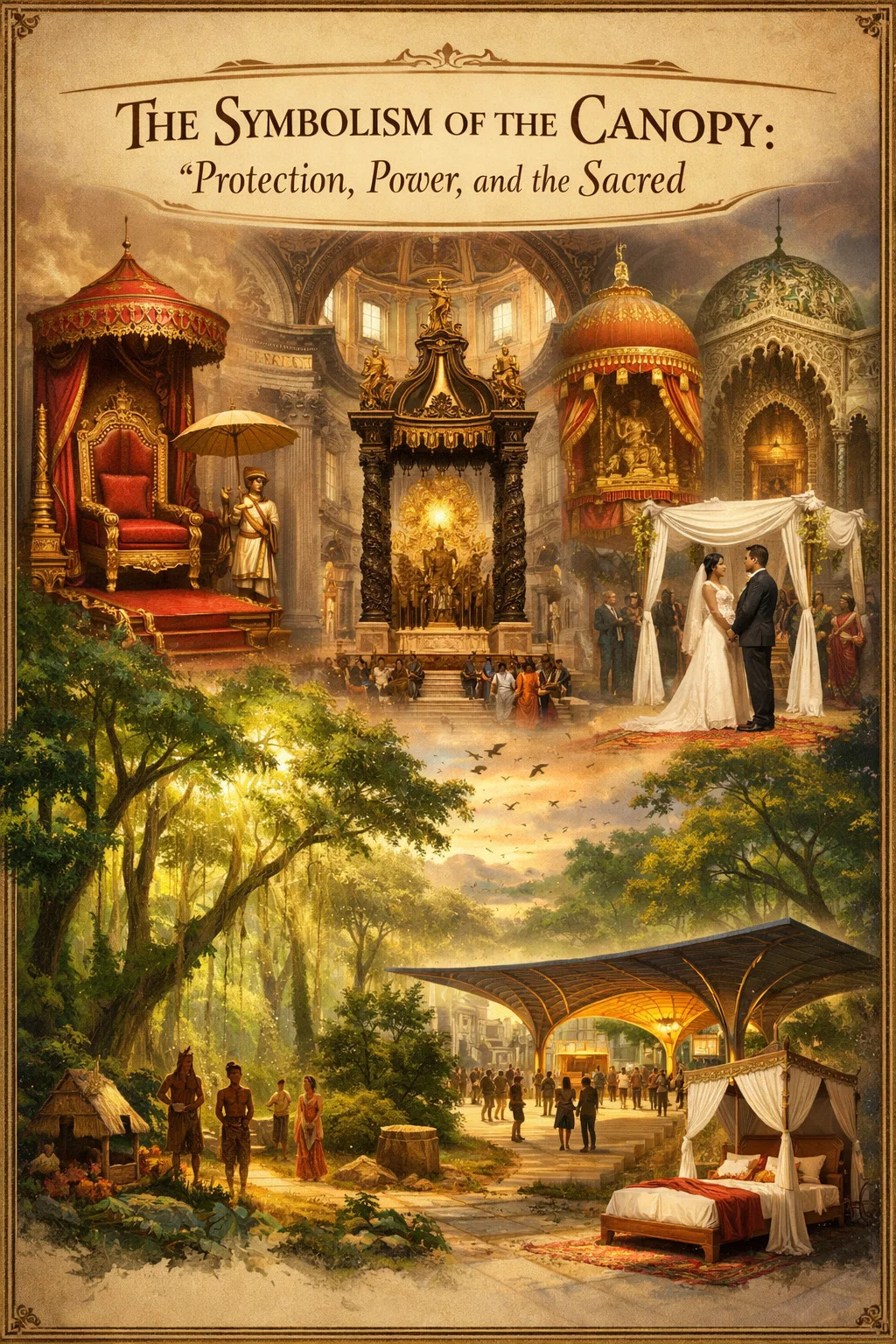
A canopy symbolizes protection, divine authority, elevated status, and the boundary between the earthly and the sacred. Across thousands of years and dozens of cultures, the canopy — whether a ceremonial baldachin over a throne, a wedding chuppah, a forest tree canopy, or an architectural overhead shelter — carries layered meaning that goes far beyond its physical function of providing shade or cover.
At its most fundamental level, a canopy creates a defined space beneath it. That enclosed overhead space signals that whoever or whatever stands under it is set apart — protected, honored, consecrated, or powerful. The symbolism is universal precisely because the gesture is instinctive: to place something overhead is to shelter and to elevate simultaneously.
Understanding canopy symbolism requires looking at several distinct but overlapping domains: political and royal iconography, religious ritual, natural ecology, architecture, and modern ceremony. Each domain reveals a different facet of what the canopy means — yet all share the same root idea of a sheltering overhead form that transforms the space beneath it.
Royal and Political Canopies: The Overhead Sign of Sovereign Power
In political and royal contexts, the canopy is one of the oldest symbols of sovereignty in human history. From ancient Egypt to medieval Europe to the imperial courts of China and India, placing a canopy over a ruler communicated — without words — that this person existed in a different category from everyone else.
In ancient Egypt, pharaohs were depicted beneath canopies during processions and court ceremonies. The canopy signaled that the pharaoh was under the direct protection of the gods, literally shielded from the same sun that bore down on ordinary people. The parasol, a close relative of the canopy, was carried over rulers in ancient Mesopotamia, India, and sub-Saharan Africa as an explicit marker of divine favor and untouchable status.
In medieval European courts, the baldachin — a permanent canopy of rich fabric suspended over a throne — became one of the most recognizable symbols of royal and papal authority. The word "baldachin" itself derives from Baghdad, reflecting the prestige of the luxurious silk fabrics imported from the East and used to construct these structures. The physical richness of the canopy material directly communicated the wealth and reach of the power beneath it.
When a canopy was carried in procession over a monarch or a religious dignitary, it served a dual function: it shielded the figure from the elements, but more importantly it visually separated that figure from the crowd. No one else walked beneath the canopy. It created a mobile sacred zone, a portable piece of the throne room carried into the street.
This symbolism persisted well into modernity. State canopies still appear at coronations, formal processions, and diplomatic ceremonies in many parts of the world. In Thailand, the number of tiers on a royal canopy traditionally indicated the precise rank of the person beneath it — a nine-tiered white umbrella canopy was reserved for the king alone, while nobles of various ranks were entitled to progressively fewer tiers.
Religious Symbolism of the Canopy: The Sacred Threshold
Religion has made perhaps the deepest and most sustained use of canopy symbolism. In almost every major faith tradition, the canopy marks a threshold — a point where the ordinary world ends and the sacred begins.
The Jewish Chuppah
In Jewish tradition, the chuppah is the wedding canopy under which a couple stands during the marriage ceremony. The chuppah symbolizes the new home the couple will build together, but its meaning extends further. It represents the presence of God as a sheltering force over the marriage. The open sides of the chuppah — it has a roof but no walls — symbolize the hospitality the couple will extend to family and community, echoing the tent of the patriarch Abraham, which was said to be open on all sides to welcome guests.
The chuppah transforms the space beneath it into holy ground for the duration of the ceremony, functioning as a temporary sacred architecture that makes a wedding valid in Jewish law. The canopy overhead signals that God is witness to the covenant being made below.
The Christian Baldachin and Ciborium
In Catholic and Orthodox Christian churches, the baldachin — or ciborium — stands over the altar or tabernacle containing the Eucharist. The most famous example in the world is Gian Lorenzo Bernini's bronze baldachin inside St. Peter's Basilica in Rome, completed in 1634. Standing nearly 29 meters (95 feet) tall, it is the largest bronze structure in the world and marks the precise spot above the tomb of St. Peter.
The placement of this architectural canopy communicates directly: the space beneath it is the holiest point in the building, the spot where heaven and earth intersect. The canopy overhead frames that vertical axis, pointing simultaneously down to the relic below and up through the dome to the sky above.
Hindu and Buddhist Ceremonial Canopies
In Hindu iconography, deities are frequently depicted beneath ornate canopies called chhatras or toranas. The canopy over a deity's image in a temple signals divine presence and protection. In Buddhist art and architecture, the chattra — a tiered ceremonial umbrella — tops stupas and Buddha images as a symbol of the Buddha's spiritual authority and his transcendence of ordinary existence. The multiple tiers of the chattra represent the layers of heaven the Buddha has traversed.
In Islamic architectural tradition, muqarnas — honeycomb-like vaulted canopy structures — appear in mosque domes and niches. While their function is partially decorative, they symbolize the infinite complexity and generosity of the divine, a canopy of spiritual abundance suspended above the worshiper.
The Forest Canopy as Symbol: Nature's Overhead World
Outside of human ceremony and architecture, the forest canopy carries its own potent symbolism — one that has shaped literature, mythology, spiritual practice, and ecological thinking.
The forest canopy is the uppermost layer of a forest, formed by the crowns of the tallest trees. In tropical rainforests, the canopy typically sits between 30 and 45 meters (100 to 150 feet) above the forest floor, creating a dense overhead layer that intercepts the majority of incoming sunlight. This canopy layer is one of the most biodiverse zones on Earth — it hosts an estimated 50% of all terrestrial species despite covering a relatively small fraction of the planet's surface.
Symbolically, the forest canopy represents:
- Shelter and maternal protection — the canopy shields the life beneath it from harsh sun, heavy rain, and extreme temperature swings. It is the forest's own roof, nurturing what grows below.
- Mystery and the unknown — in literature from fairy tales to contemporary fiction, the forest canopy represents the boundary between the knowable human world and the wild, mysterious world beyond. Entering a forest whose canopy blocks the sky is a threshold moment in countless narratives.
- Interconnection and community — modern forest ecology has revealed that the tree canopy is deeply networked underground through mycorrhizal fungal connections. The canopy overhead reflects a community of mutual support below — a symbol of cooperation rather than isolation.
- Life source and abundance — because the forest canopy captures solar energy and drives the productivity of the entire ecosystem beneath it, it symbolizes generosity and the fundamental source of sustenance for all who shelter below.
In Indigenous cultures across the Amazon basin, Southeast Asia, and Central Africa — where the forest canopy is a literal ceiling of daily life — the canopy is often understood as a living roof provided by the forest gods or ancestral spirits. Its health is directly tied to the health of the community below. When the canopy disappears through deforestation, it is experienced not only as ecological loss but as a spiritual rupture.
Canopy Symbolism in Architecture and Design
In architecture, the canopy — whether a projecting roof, an entry awning, a suspended ceiling structure, or a pergola — carries symbolic weight that skilled designers have always understood and deployed intentionally.
An entry canopy on a building tells visitors that the transition from outside to inside is significant. It marks a threshold. Grand hotels, courthouses, government buildings, and places of worship almost universally feature pronounced entry canopies precisely because the canopy signals: you are entering a different kind of space. The overhead element creates psychological shelter even before the person passes through the door.
In residential design, the bed canopy — the four-poster canopied bed — has symbolized wealth, intimacy, and a protected inner world since at least the medieval period. The hangings around a canopied bed created a private room within a room, a space of shelter and rest set apart from the larger hall. In royal contexts, the bed canopy was as much a symbol of rank as the throne canopy — visitors to a monarch's bedchamber would still bow to the empty canopied bed as a symbol of the sovereign's power.
Contemporary architecture has returned to canopy forms with renewed interest. Architects like Zaha Hadid, Snøhetta, and Kengo Kuma have designed dramatic canopy structures that serve as symbolic gestures — overhead forms that define a gathering place, mark a civic identity, or create a sense of shelter in open public space without enclosing it. The canopy says: this place matters, and you are welcome beneath it.
| Canopy Type | Context | Primary Symbolism |
|---|---|---|
| Baldachin | Church altar / Throne | Divine presence, sacred authority |
| Entry canopy / Porte-cochère | Public buildings, hotels | Welcome, threshold, prestige |
| Bed canopy | Domestic / Royal interior | Intimacy, rank, protection |
| Public plaza canopy | Urban civic space | Community, gathering, shared identity |
| Pergola / Garden canopy | Residential / Landscape | Nature connection, leisure, belonging |
The Canopy in Wedding and Ceremonial Traditions Around the World
Weddings are among the most canopy-rich of all human ceremonies, and this is not a coincidence. The wedding marks a transformation — two people entering a new life together — and the canopy physically marks that transformation as sacred and witnessed.
Beyond the Jewish chuppah, canopy traditions appear in weddings across a remarkable range of cultures:
- Hindu weddings — the mandap is a four-pillared canopy structure under which the marriage ceremony takes place. The mandap represents the home the couple will build and the four goals of Hindu life: dharma (righteousness), artha (prosperity), kama (love), and moksha (liberation). The canopy overhead signifies the presence of the divine as a witness and blessing.
- Chinese weddings — in traditional Chinese weddings, a red canopy was used over the bridal sedan chair to protect the bride from evil spirits during the journey from her parents' home to her new husband's home. Red, the color of good fortune, combined with the overhead protection of the canopy, formed a powerful symbol of safe passage into a new life.
- Nigerian Yoruba weddings — the aso-oke canopy held over the bride during her procession signals her elevated status on this day. She is, for the duration of the ceremony, a figure of royal dignity deserving of overhead shelter and honor.
- Western outdoor weddings — the floral arch or fabric drape canopy has become a dominant feature of contemporary outdoor wedding design. While often understood primarily as aesthetic, it continues the ancient symbolic function: it marks the spot where the vows are made as a sacred and differentiated space.
What unites all these traditions is the same essential gesture: an overhead form creates a set-apart space where transformation happens. The canopy announces that what takes place beneath it is not ordinary — it is witnessed, blessed, and protected.
What the Canopy Symbolizes in Literature and Mythology
Writers and mythmakers have consistently reached for the canopy as an image when they need to convey protection, transformation, and the meeting of worlds. The range of contexts is wide, but the symbolic logic is always the same.
In Greek mythology, the canopy of the sky itself — the vault of heaven — was personified as a dome or tent stretched overhead. The word ouranos (sky, heaven) was sometimes interpreted architecturally, as though the heavens were a great canopy above the mortal world. The gods existed above the canopy; mortals existed beneath it. To pierce the canopy — to ascend to Olympus — was to move from mortal to divine space.
In Shakespeare's plays, the canopy appears as a charged image. In Hamlet, the prince's famous description of the sky as a "majestic roof fretted with golden fire" deploys canopy imagery explicitly — the sky is understood as an architectural overhead form, and its apparent meaninglessness to Hamlet in his depression signals his estrangement from the world beneath it.
In fantasy literature, the forest canopy functions repeatedly as a threshold into the otherworld. In J.R.R. Tolkien's writing, the ancient forest of Lothlórien has a canopy of mallorn trees with golden leaves that creates an enclosed, timeless space beneath — entering this canopy means entering Elvish time, a different mode of existence. The canopy overhead marks a world apart.
In religious poetry from the Psalms to Rumi to Gerard Manley Hopkins, the sky itself — understood as God's canopy — functions as the visible sign of divine sheltering. The overhead arch, whether of stars, trees, or cloth, becomes a legible symbol of the care and enclosure of something greater than the human figure standing beneath it.
Psychological Symbolism: Why Canopies Make Humans Feel Safe
The symbolism of the canopy is not only cultural — it is also psychological, rooted in deep patterns of how human beings experience space and shelter.
Environmental psychology research consistently finds that humans prefer spaces with an overhead element — a ceiling, tree canopy, pergola, or awning — over completely open overhead space. Studies in architectural psychology show that ceilings at around 8 to 10 feet (2.4 to 3 meters) trigger feelings of focus and intimacy, while overhead openness increases feelings of exposure and vulnerability. This preference likely has deep evolutionary roots: overhead cover protects against predators and weather, and our nervous systems still respond to it as a safety signal.
The ideal human spatial preference — identified in environmental psychology as the "prospect and refuge" model developed by geographer Jay Appleton — involves a position of cover overhead (refuge) combined with an open view outward (prospect). A canopy provides exactly this combination: shelter above, openness on the sides. This is why a table beneath a tree feels instinctively more comfortable than a table in the middle of an open field, even in identical weather conditions.
When cultures attach symbolic meaning to canopies — when they place canopies over sacred objects, over rulers, over brides and grooms — they are amplifying and formalizing this baseline psychological response. The canopy already feels protective and significant to the human nervous system. Ritual and symbolism build on that foundation, declaring that the protection is not just physical but spiritual, not just personal but cosmic.
The Canopy as Symbol of Environmental Stewardship Today
In the contemporary environmental movement, the forest canopy has taken on powerful new symbolic meaning. The health of the forest canopy is used as an indicator — almost a moral gauge — of our relationship with the natural world.
Organizations like the Rainforest Alliance and Global Forest Watch use canopy cover data as a primary metric for tracking deforestation. When satellite imagery shows a forest canopy disappearing, it is communicated not only as a scientific data point but as a symbol of loss — of biodiversity, of climate stability, of Indigenous homeland, of the planet's capacity to sustain itself.
Between 2000 and 2023, the world lost approximately 1.5 million square kilometers of tree cover, according to Global Forest Watch data. Each square kilometer of lost canopy represents not just ecological change but the dissolution of the sheltering overhead world that millions of species — including human communities — depend on.
Urban tree canopy has similarly become a symbol of equity and livability. Cities with high urban tree canopy coverage — measured as the percentage of ground area covered by tree crown when viewed from above — are consistently associated with lower ambient temperatures, better air quality, higher property values, and improved mental health outcomes. Los Angeles has set a target of 50% urban tree canopy coverage by 2028, explicitly framing the canopy as a symbol of a healthy, equitable city.
In this context, the canopy has become a shorthand for everything that shelters life — a symbol that bridges the ancient human experience of seeking overhead cover and the urgent contemporary challenge of maintaining the natural systems that make life on Earth possible.
Summary: The Layered Meanings of Canopy Symbolism
The canopy is one of the most consistently meaningful forms in human experience — a shape that carries authority, protection, the sacred, and the natural all at once. Its meaning holds across radically different contexts because it is grounded in something real: the fundamental human experience of what it feels like to have shelter overhead.
Whether the canopy takes the form of:
- A silk baldachin over a medieval throne signaling royal authority
- A Jewish chuppah marking the sacred space of a marriage covenant
- A Hindu mandap defining the ritual space of a wedding ceremony
- A tropical forest canopy sheltering millions of species in a vertical ecosystem
- An architectural entry canopy marking a building's threshold with dignity
- A city's tree canopy as a metric of environmental and social equity
— the symbolic logic is the same: the canopy creates a space beneath it that is set apart, sheltered, honored, and meaningful. Whatever stands beneath a canopy is declared to be more than ordinary. The overhead form reaches across the gap between the physical and the symbolic, between the natural and the cultural, and holds them together in one of humanity's oldest and most eloquent gestures.